Summer series 2026 · you were not there

Documenting processes used to take years. This summer we showed how it can be done in days, and still hold up.

Three sessions, fully recorded, with the slides and every question answered: it is all below, free to watch and to pass on. And if you want to know what this does with your own document, send it in and you will have a validated diagram back within 48 hours. Free of charge, and the diagram is yours to keep.

Send your toughest document Watch the recordings first
A validated diagram back within 48 hours A document is optional: getting in touch is enough The diagram is yours to keep
Quincy Diepeveen, De ProcesToppers

No time? This is the whole story in a few minutes. Open on YouTube

In Dutch, with auto-translated English captions available.

The three sessions

Three sessions, fully recorded. Watch at your own pace.

Each session stands on its own, so start wherever your question lies. Every question asked during the sessions is answered in writing in the document below.

The sessions were recorded in Dutch. Versions with English subtitles are being produced and will replace these recordings here. Until then, YouTube's automatic English captions work well: press CC, then Settings, Subtitles, Auto-translate, English.

Session 1 · 18 August

From document to process, in minutes

How a work instruction becomes a complete BPMN diagram, with an expert who approves it. Start here if your documentation exists but nobody dares to build on it any more.

Open on YouTube

Session 2 · 1 September

Getting a grip on your process landscape

Why a process landscape is more than a filing structure, and how a first version is in place within minutes. Start here if the backlog grows faster than you can draw.

Open on YouTube

Session 3 · 8 September

Keeping it current, without manual work

The closing session: how the landscape stays accurate without eating up your diary, and how an interviewer that asks its own questions gets the knowledge out of people's heads. Start here if documenting ground to a halt when that one colleague left.

Open on YouTube

To download or pass on
If you want more

Want to see what this does with your own document? You will know within 48 hours.

Send in your toughest process document. Within 48 hours you will have a validated diagram back, approved by an expert, with our observations included. It costs nothing and the diagram is yours to keep. All the research and drawing work is on our side.

No document to hand yet? You can send the form without one, and I will choose one together with you.

What it gives you
✓Your week goes back to improving things. Ploughing through documents, chasing people and drawing diagrams come off your plate.
✓The backlog becomes something you can clear. Minutes per document instead of days; a year of work in weeks.
✓Answers on the day you need them. Audit, data breach or new legislation: the landscape is in place and accurate.
✓Knowledge secured before anyone leaves. When that one colleague moves on, the knowledge stays.
Rather talk first for half an hour, about your own material? Book half an hour in my calendar
The trial process · free

One of your documents. A validated diagram back.

We arrange confidentiality in advance, and processing stays within Europe. Nothing becomes final until a person has approved it.

Prefer email? Send your document to quincy@procestoppers.nl. We arrange confidentiality in advance, and the diagram is yours to keep.
A validated diagram back within 48 hours Confidentiality arranged in advance The diagram is yours to keep

Why we built this, the proof, and why this is not a chatbot

Why we built this

We did this work by hand for ten years. Then we rebuilt ourselves.
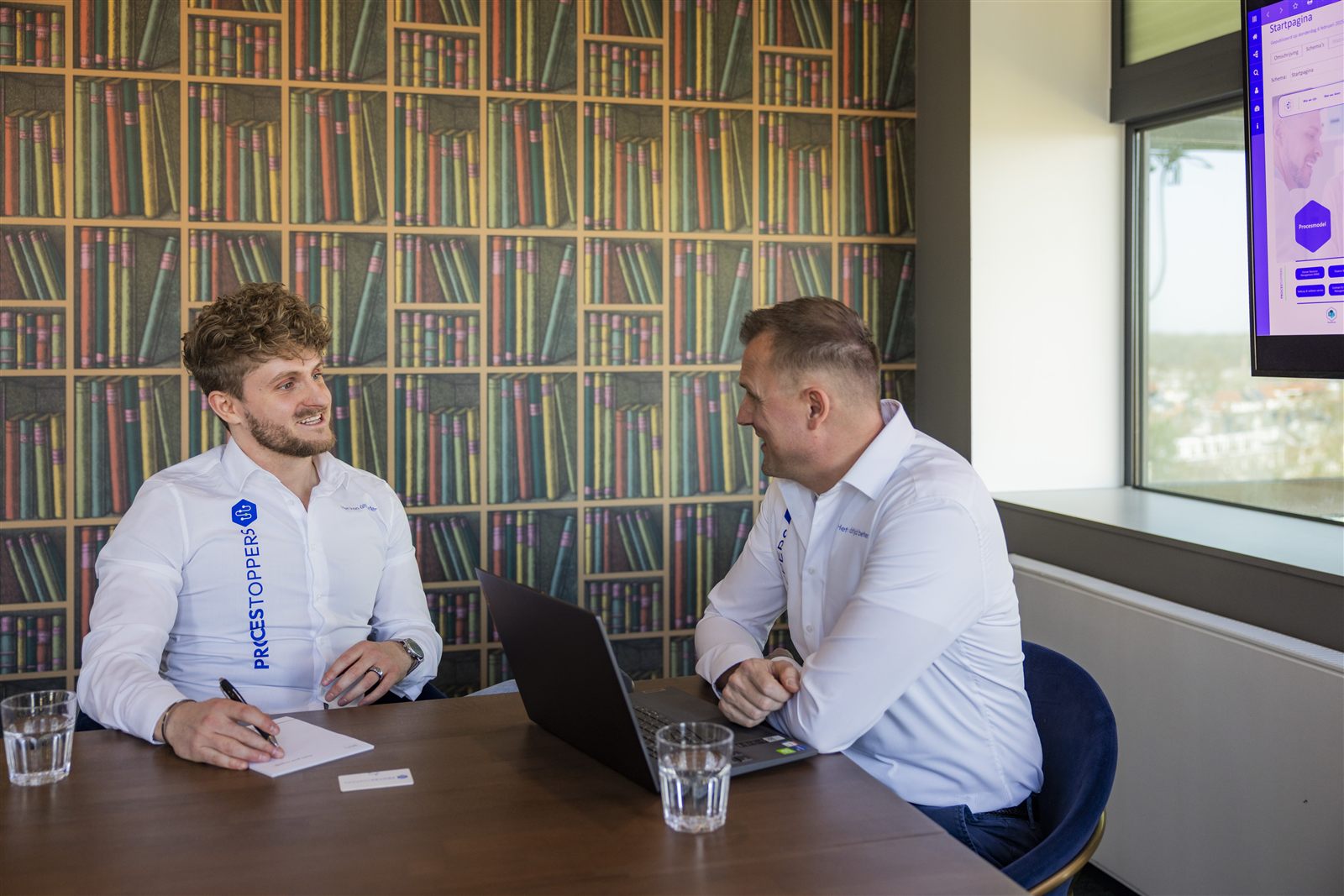
Quincy Diepeveen and Remco Kauderer at a table, discussing a process
Quincy and Remco, De ProcesToppers.

In government, I once saw the as-is landscape alone take two and a half years to produce. Two and a half years of drawing, digging through material and chasing people who no longer worked there. And by the time it was finished, the first part was already out of date.

That is not an exception; that is how the profession has worked for thirty years. So Remco and I did something different: we rebuilt our own work. An algorithm trained on everything the two of us have seen between us in twenty-five years: how to get a process out of a messy document, when to split it up, which questions to ask when something does not add up.

And the most important part we deliberately left unautomated: judgement. Every diagram is approved or rejected by a person before it exists. That is not a limitation; that is the product.

Quincy Diepeveen Co-founder of De ProcesToppers, together with Remco Kauderer
The proof

This goes in. This comes out.

Not a demo built on someone else's example, but a real document and the validated diagram the engine made from it. Recorded live, unedited.

A 27-page work instruction goes in, the validated diagram comes out.

How it works, in five steps

1. You choose your document. A work instruction, a policy document, a spreadsheet or the minutes of a meeting. The messier it is, the more clearly you see the difference.

2. The engine does all the work. It pulls the process out of the noise, splits processes that are too large and puts roles in the right lanes.

3. The algorithm checks itself. Anything missing or doubtful becomes a question for you, not a guess.

4. It lands in your own tooling. Export to your own platform, or tool-independent as BPMN 2.0, PDF and a written description. You are not locked in to anything.

5. You validate with the business. Green, amber or red for each part. Nothing becomes final until a person signs it off.

“

This is the output I expect. There is real promise in this.

Process adviser at a municipality, after the trial process on their own document
“

We budget 160 hours for describing a single process. This can be done differently, and faster.

Project leader at a large municipality, about the old way of working
“

Normally this would have taken me three months; soon it will take thirty minutes. That is something I can take to my manager.

Process improvement adviser at a transport company, after the health check on his own environment

Quotes from our conversations over the past few weeks, translated from Dutch. We leave out names because we only name references with written permission.

Surely a chatbot can do this too?

Why this is not a converter. And not a chatbot.

No. Two minutes that explain the difference: a model that knows one discipline, understands first and only then draws, with a person who approves. The on-screen text is in Dutch for now; the images carry most of the story, and an English version is on its way.

Watch full screen
What is holding you back

The questions everyone asks. Answered honestly.

Or ask Quincy your question first

What happens to our documents?

They are used solely to create your diagrams. Everything runs within Europe: a cloud environment in Ireland and applications hosted in Germany. A pseudonymisation and anonymisation layer automatically checks whether a document still contains personal data before anything is analysed.

We arrange confidentiality and data processing agreements in advance, and on request we delete everything afterwards. For the trial process you do not need confidential content anyway; an outdated work instruction is enough to see the difference.

Surely a chatbot can do this too?

A simple conversion, yes: a handful of activities in a small diagram. The difference lies in complexity and expertise. Splitting a long, messy document into several work processes, putting roles in the right lanes, asking questions about gaps instead of guessing, and doing all that at the level of detail at which organisations really work: that is where a general-purpose chatbot gives up, because it has no process management knowledge and does not know which questions to ask.

You do not have to take our word for it: send your toughest document and judge the result yourself. That is what the trial process is for.

Does this only work for new processes?

Quite the opposite. Existing documentation, old diagrams and even meeting notes are the raw material. And you can load your existing environment as XML: the system reads it, scans the entire structure and puts your current situation next to the generated version, so you can see what is missing, what is outdated and what can go.

Do we have to switch tools?

No. The output lands in what you already have, or comes tool-independent as BPMN 2.0, PDF and a description document. No connection to your systems is needed either: import and export run via files, so your IT department does not have to open anything up. Your current licences simply stay in place.

Can we keep our own conventions and house style?

Yes. You can supply your own conventions document, and an organisation scan picks up your information and colours. The standard view is configurable, right down to the colour of the activities.

How much of our time does it take?

Choosing and sending one document, and half an hour to go through the outcome together. All the research and drawing work is on our side. After that, you decide whether to take it further; the diagram is yours either way.